Modern food and non-food retail is facing fierce competition, declining consumer loyalty, and constant pressure on margins. This is especially true during wartime and with rising operating costs associated with electricity shortages and fuel costs for generators. In these conditions, Digital Signage solutions are becoming even more relevant in the chain retail segment. After all, advertising screens or digital menus can be turned into a strategic tool for managing sales, consumer behavior, and the operational efficiency of the chain.
Digital signage technology consists of two key components:
- Software (Digital Signage Software) for centralized content management on an unlimited number of devices.
- Hardware (Digital Signage Hardware) in the form of screens of various shapes, sizes, and resolutions, often integrated into commercial equipment.
It is the synergy of these two components that forms the measurable ROI.
The comprehensive implementation of Digital Signage Software and Digital Signage Hardware allows large chains to automate all content management processes on various playback devices, which is a top priority in the face of growing competition in the network retail segment.
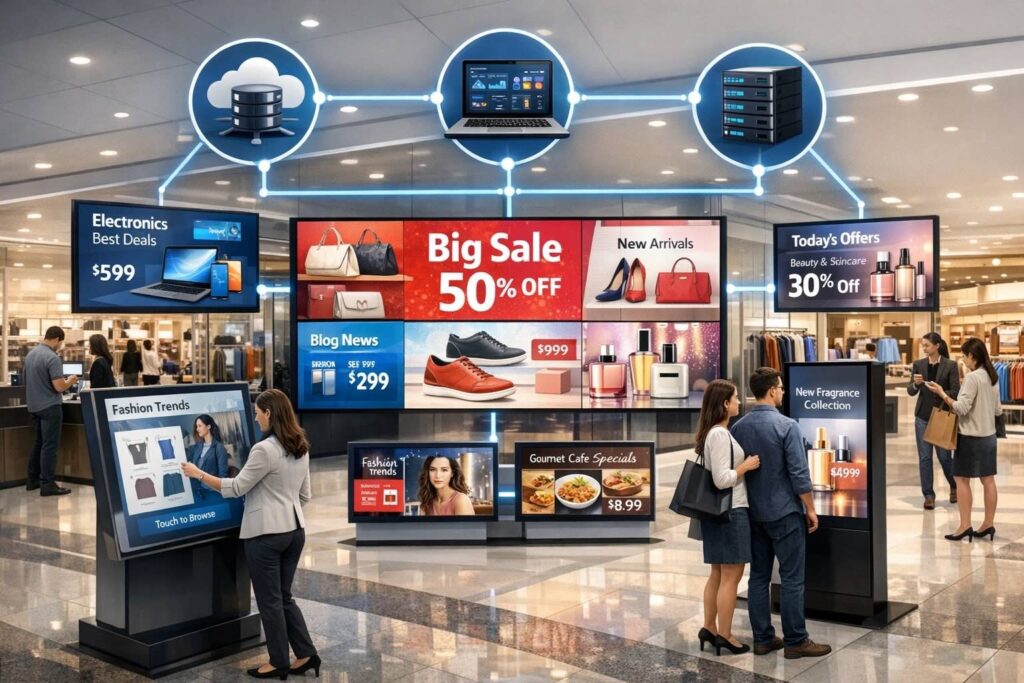
Advertising screens, digital menus, and electronic price tags are becoming an integral part of successful chain retail. It is clear that centralized content management, the ability to segment by region or format, and the ability to “flexibly configure” broadcast schedules with instant response to price changes when integrated with ERP, CRM, BI, and loyalty programs are only possible with the implementation of Digital Signage.
Modern SaaS platforms, such as DSGO.pro, allow you to manage content remotely 24/7, scale the system without significant capital investments, while monitoring the operation of all equipment online and analyzing its efficiency.
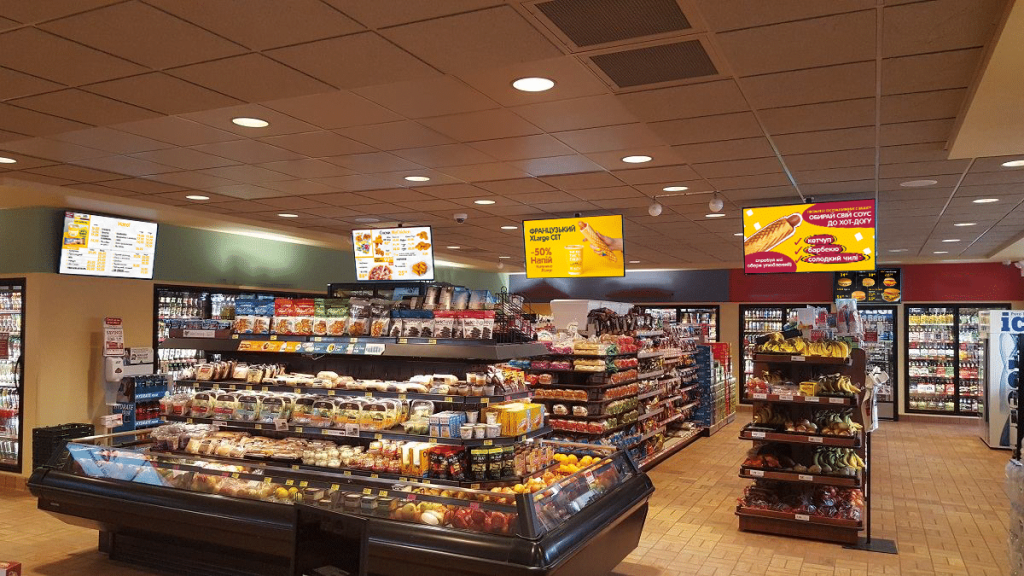
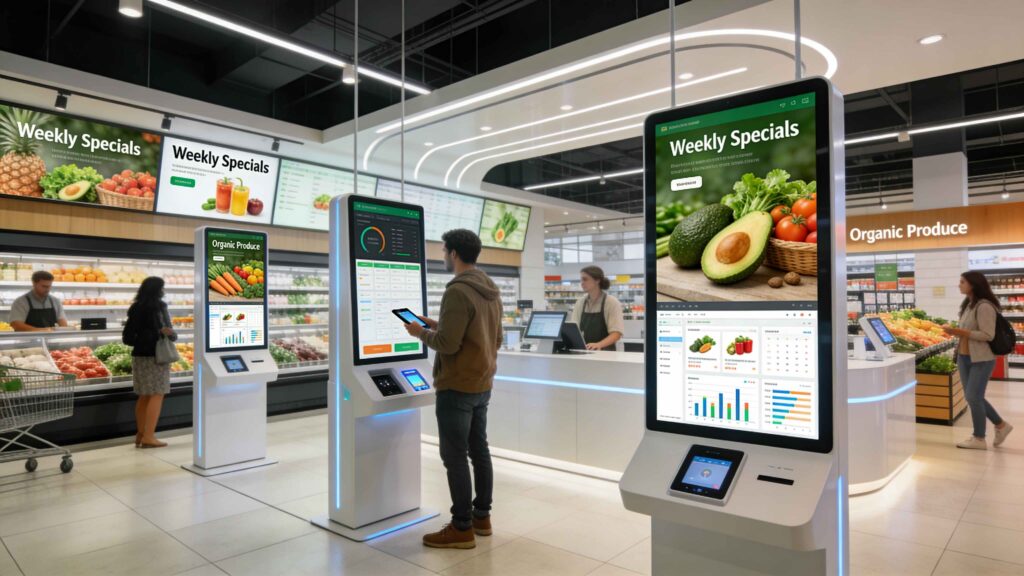
It is evident that LED or LCD screens are becoming part of retail architecture. Today, digital signage hardware is not limited to standard panels or TVs of various sizes and specifications. It is a mix of software and hardware solutions integrated into a single infrastructure that becomes part of commercial equipment. Here are a few types of equipment and locations that affect performance.
No. 1 Entrance area – a vertically or horizontally positioned screen (depending on the store layout) next to the shopping carts is the TOP solution in terms of investment volume/growth of advertised offers. The probability of contact with the content reaches ~80%. Broadcasting information on such a screen from the first step “encourages” the consumer to make an unplanned purchase, realizing its necessity (it is recommended to broadcast a special offer with the maximum discount or a provocative message such as “limited offer”).
No. 2 Advertising screens integrated into shelving – screens are the trend for 2025-2026. Built into shelving systems, they operate in the decision-making zone. 100% guarantee of visual content with content, and properly prepared content in tandem with a call to action significantly increases the likelihood of moving the advertised product from the shelf to the basket.
No. 3 Digital Shelf Talker – screens with non-standard resolution integrated into the shelf. Their task is to provide information about the price, present the advantages of the product, and stimulate impulse purchases. As a rule, these are small 13-21 inch screens that are placed near the product and broadcast advertising and informational content.
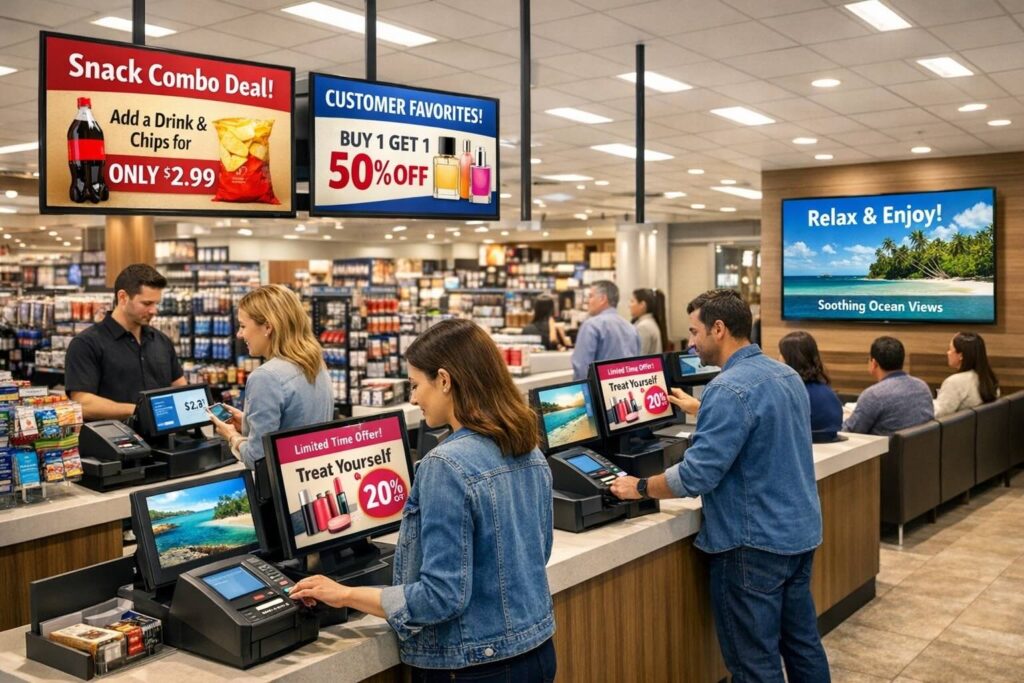
Cashier area equipped with an advertising and information screen – stress reduction and stimulation of cross-selling and up-selling.
Many chains in the HoReCa and Retail segments in Ukraine are already successfully using DSGO.pro solutions from Innovative DMC, understanding that Digital Signage is no longer an “auxiliary” tool but is becoming a central element of the retail ecosystem, which:
- increases engagement → affects sales
- reduces operating costs
- increases the effectiveness of promotional campaigns
- allows you to adapt instantly
Digital Signage software and hardware solutions are tools for managing attention and purchasing behavior that allow you to increase impulse sales, strengthen brand communication, and create a scalable digital network infrastructure.
Top 3 mistakes when implementing Digital Signage in network retail and how they eat away at your ROI
Digital signage in retail is no longer about “beautiful screens,” but about managing the buyer’s attention at the moment of decision-making. However, most chains make the same systemic mistakes.
Mistake #1: When a project is perceived as an AV purchase rather than the construction of commercial infrastructure: there are no approved KPIs, no integration with POS, no content strategy, and no analytics tools. The result? Screens are installed, but sales remain largely unchanged.
The right way: start with your goals (SKU uplift, average check growth, promo effectiveness), analyze the market for solutions and implement a platform that meets your objectives, integrate with POS/ERP, and launch A/B testing of content.
IMPORTANT: Digital signage is a revenue tool, not a decorative element or a desire to “keep up” with competitors based on the principle of “everyone else is doing it, so I need to too.”
Mistake #2: Incorrect placement
The “where it was” screen ≠ the “where the decision is made” screen.
Critical areas: entrance (up to 80% coverage), shelf (moment of choice), and checkout (impulse purchases). The shelf-level format — Digital Shelf Talker — is particularly underestimated. It is this format that influences the redistribution of shelf space. Correct placement of the screen in the most suitable location accounts for more than 50% of the project’s success.
Mistake #3: Lack of centralized management, use of local flash drives, different versions of promotions, untimely price updates, inability to monitor screens in real time, etc. For a network of 50+ stores, this turns into “operational chaos.”
The right solution: cloud CMS, role-based access, automatic scheduling, 24/7 monitoring (online/offline) with the ability to distribute roles and access rights (administrator – can do EVERYTHING, content manager – configure display settings, designer – edit or update content).
Now the main thing is the numbers. Digital signage must pay for itself. Below is a simplified ROI model.
Example of ROI calculation (scenario: 3 screens per store – entrance, shelf, checkout)
Initial parameters:
- Average store revenue: $1,200,000/year
- Average check: $12
- Traffic: ~100,000 shoppers per year
- Number of screens: 3 pcs
- DSGO.pro SaaS license: $3/screen/month.
- Additional sales uplift: 1.5–3%
ROI Retail – up to 50 stores
A chain of 50 stores
Annual turnover of the chain: 1,200,000 × 50 = $60,000,000
If Digital Signage provides a +2% uplift: $60,000,000 × 2% = $1,200,000 in additional revenue
Even with a 20% margin: $240,000 in additional profit
Costs: 150 screens × $3 × 12 months = $5,400 (DSGO.pro SaaS)
Even taking into account equipment and implementation (~$150,000–200,000): payback period of 6–12 months.
| Network of 150 stores Turnover: $180,000,000 + 2% uplift = $3,600,000 Margin 20% = $720,000 additional profit DSGO.pro SaaS: 450 screens → $16,200/year. The scale of the network dramatically increases the financial effect. | Network of 300 stores Turnover: $360,000,000 + 2% uplift = $7,200,000 Margin 20% = $1,440,000 profit DSGO.pro SaaS: 900 screens → $32,400/year |
In this business model, digital signage becomes not just another expense item, but a tool for growing network capitalization. It is important to understand that digital signage in the retail segment works primarily through impulse purchases, enhanced promotions, SKU redistribution, increased average check size, and reduced dependence on printed materials. The effect is significantly amplified when scaled.
Anyone interested in online retail in Ukraine will surely find it interesting to learn about the business case, namely the projects for implementing software and hardware solutions in one of the capital’s market chains, LotOK.
CONCLUSION: If the system is implemented correctly, Digital Signage software and hardware solutions become an effective tool for LFL growth, a driver of impulse sales, and an additional media asset for the chain. By 2026, this will no longer be an “option” but an integral part of a successful business model for the retail chain segment.