In today’s dynamic digital era, when the market sets the rules across all industries, HoReCa, Retail and Entertainment are no exception. Business owners, including cinema operators, actively compete for audiences, making the adoption of innovative technologies that help reduce costs and increase profits more relevant than ever.
In this regard, Digital Signage technology (digital signs, advertising monitors, video walls, etc.) has proven itself excellently. These solutions genuinely work — attracting and retaining customers, helping to lower costs and increasing a cinema’s competitiveness.
Experts claim that in terms of return on investment (ROI) and increased profitability for a cinema, café, restaurant or bar, digital signage is the most effective solution.
Implementing Digital Signage solutions based on the iDS Cloud platform improves communication effectiveness with target audiences. The automation system for centralized content management on digital playback devices solves all related challenges.
From the standpoint of interactive engagement, high‑quality service presentation and consumer involvement, there is currently no better solution on the market.
Installing a centralized content‑management system using the iDS Cloud hardware‑software suite from Innovative DMC in a cinema, café, bar, nightclub or gym allows businesses to unite management of all screens with various content types and data sources into a single system.
Monitoring the correct operation of the entire system or each individual monitor/device is performed online in real time. Therefore, administration can be carried out remotely from anywhere in the world by a single specialist (regardless of the business scale).
Support for working with different databases enables automated display on screens not only of schedules but also, for example, digital menus, ticket prices, cinema‑bar assortment offers and more.
In addition, Innovative DMC’s software can fully automate session schedule broadcasting in a cinema, display trailers and configure “smart” film advertising modes such as “Premiere”, “Today” and “Coming Soon.”
With a few clicks, an administrator can configure the display of various information on LCD monitors or video walls. For example, an automation system in a cinema typically shows genre, age rating, runtime, upcoming session data and time until start, auditorium navigation and other useful viewer information.
Thus, content management on digital menus in café areas, video walls, LED digital posters, interactive monitors, trailer and schedule screens, as well as box‑office monitors — as mentioned earlier — is carried out centrally.
A unified design concept is used since operational data (schedule templates, ticket price, film title and attributes — 3D, dubbing language, auditorium, etc.) are pulled on the fly from the single system, along with film trailers or promotional‑informational messages.
In addition to the iDS Cloud hardware‑software suite, LLC “IDMC” offers a full range of services for developing high‑quality content: clips for digital menus and advertising videos for cafés, bars and restaurants.
Professional photo and video shoots, creation of 2D/3D animation and other content development or adaptation services are provided.
Content in the restaurant business is the “lifeblood” of digital menus; profit depends on its quality and refresh frequency. Dynamic content is at least three times more “appetizing”, expressive and attractive than a static image — it provokes the consumer to take an impulsive action.
Every detail matters when creating sales‑driving content for digital menus in the restaurant business.
The time of visual contact, the optimal frequency of content rotation in a playlist together with bright/dynamic content more effectively influences consumer impulse decisions in favor of the promoted offer. For example, replacing a static lightbox menu with a dynamic digital menu board increases sales on average by 15–20%.
The primary task of a digital menu in the HoReCa segment is to influence the customer to make the business‑most‑profitable decision directly at the point of contact.
INCREASE IN NUMBER OF CINEMA‑BAR CHECKS — over 10%
INCREASE IN AVERAGE CHECK SIZE — over 15%
INCREASE IN SALES OF COMBO OFFERS — over 20%
In modern cinemas there are at least five main communication channels with the target audience, whose effective use directly impacts the business’s financial growth — whether it’s a cinema, café, restaurant, bar or nightclub.
The first is video walls. Standard, mosaic, vertical, horizontal, composed of high‑brightness, high‑resolution LCD or LED screens.
During planning or in an operating venue, a video wall always looks impressive and is often a key focal point. Video walls are usually installed in the lobby or entrance area.
Video walls are used in cinemas located in shopping and entertainment centers (malls) or in high‑traffic areas.
This is an “external” communication channel that increases visits through informative display to mall visitors. A digital monitor vividly informs passersby about upcoming premieres or screening schedules.
It’s simply impossible to walk past a bright, dynamic large advertising‑informational display playing interesting content.
This communication channel is maximally effective for promoting upcoming events. Using video walls also elevates the venue’s image and status, increasing contacts with the target audience.
The second channel for increasing a cinema’s profitability is reducing ticket‑purchase time — the use of interactive TOUCH monitors. Implementing self‑service kiosks (for ticket purchases) is the first step in solving this problem.
It is proven that the most negative service experience occurs in queues. The longer we wait, the more negative our memory of the venue becomes.
Innovative DMC’s flexible software interaction with various databases allows integration with any ticketing system.
A friendly, intuitive interface quickly orients users to information: program lineup, film trailer and short description, age category, runtime/format of the session, auditorium locations and number of available seats, etc. Visitors receive key information in just a few touches.
Statistics show that about 40% of moviegoers come to the cinema not for a specific film but simply to relax and have a good time.
Auditorium wayfinding is supported by the third channel of communication — informational monitors.
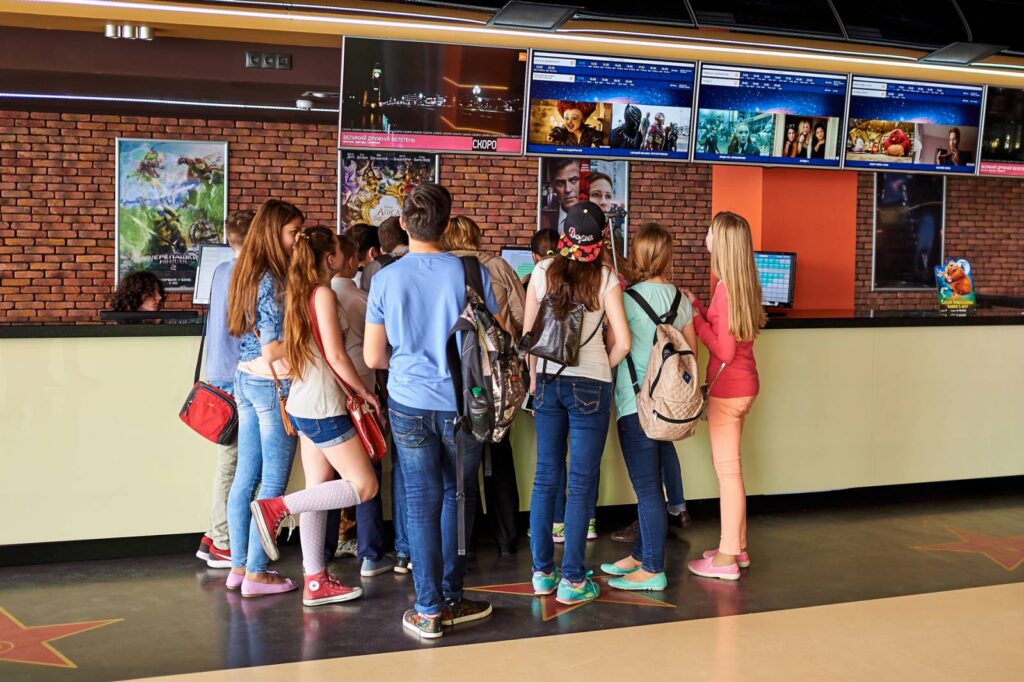
In such cases movie choice is spontaneous or guided by information on monitors placed near box offices. Proper placement of advertising or informational monitors effectively communicates current screenings (film title, age rating, runtime, time to next session), upcoming premieres and film schedules. This helps visitors orient faster and decide on a film, and repeated trailers on monitors help them remember which film to watch in the near future.
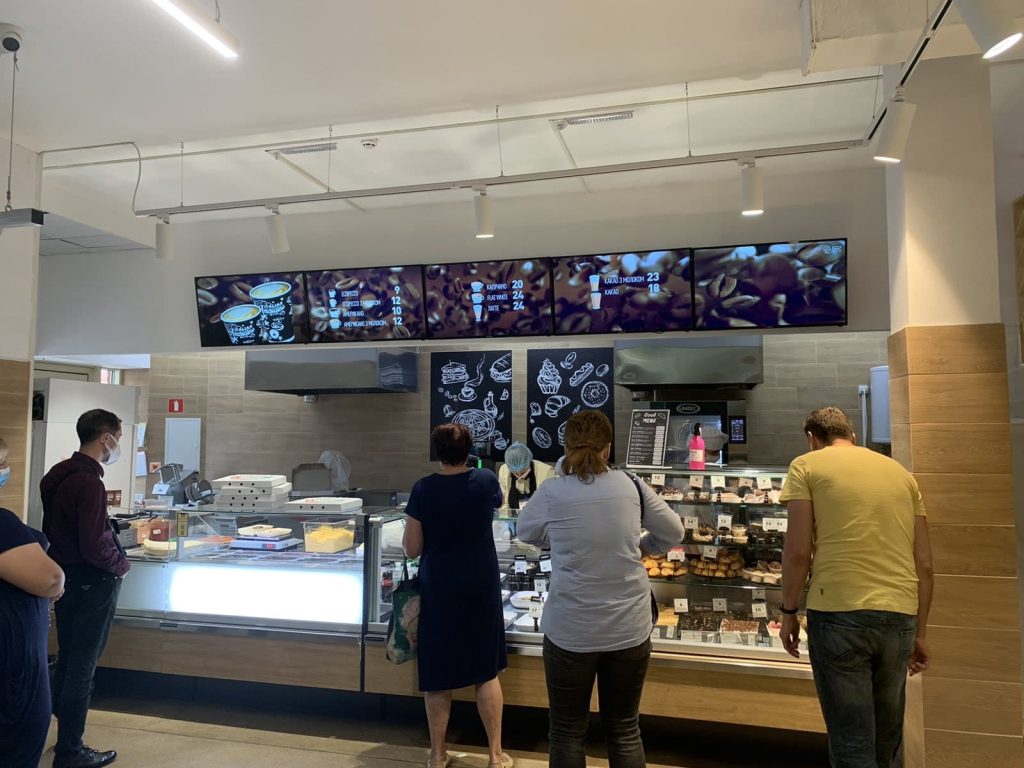
Digital menus or monitors in the concession‑bar area are the fourth and most popular HoReCa and cinema/f‑court communication channel in terms of increasing profitability. In some cinemas, concession sales account for over 30% of total profit. Using appetizing, bright, attractive digital menus and dynamic content elevates product presentation to a new level. Attractive prices, discounts and special offers, children’s combo menus, etc. — these form the basis for increasing average check and overall sales volume and profit.
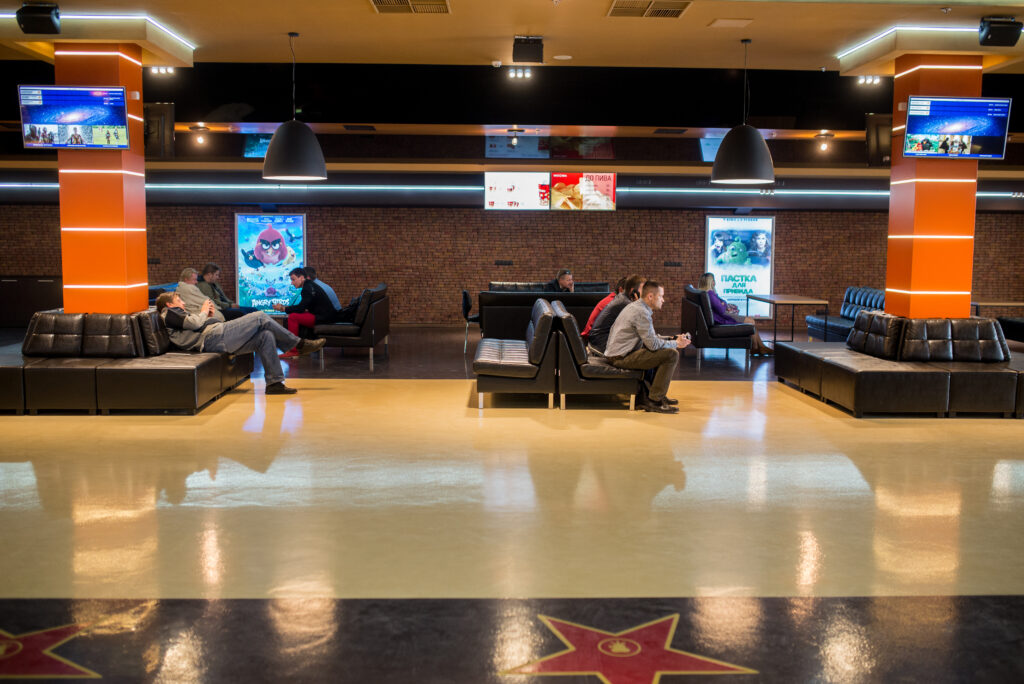
The task of the fifth communication channel — navigation screens indicating where and how soon the next session will start — is to increase visitor loyalty and work for the future. Monitors in the cinema lobby target viewers who have already chosen a film, bought tickets, ordered popcorn and drinks and are waiting for the session to start. Such screens unobtrusively introduce attendees to new releases, which can positively influence their decision to return to the cinema soon.
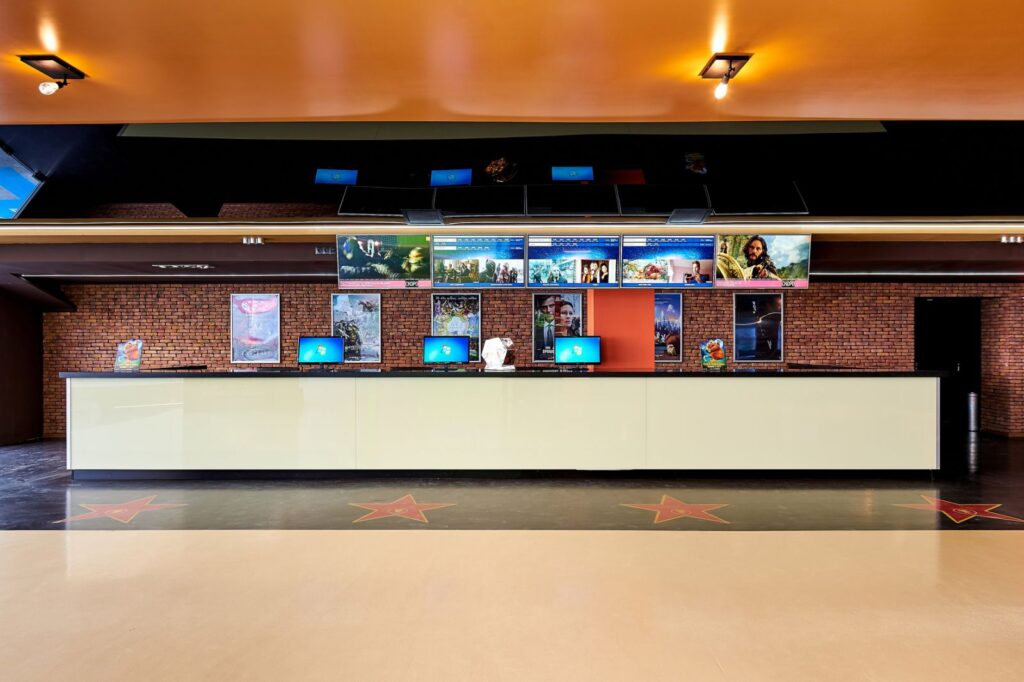
Innovative DMC has extensive practical and theoretical experience implementing Digital Signage & Interactive Technologies projects. The company’s specialists provide full project support at all stages — from planning to implementation: approval of floor plans, development of communication maps, structured cabling system (SCS) construction and commissioning, approval of design projects and other engineering and construction documentation.
As experts in automating centralized management of audio/video content and monetizing innovations in cinemas, Entertainment, HoReCa and Retail, the company’s consultants help avoid mistakes even during the project discussion stage.
Innovative DMC’s technical specialists have the necessary knowledge and are ready to offer comprehensive services for supplying, installing, integrating and implementing the iDS Cloud hardware‑software for centralized content management on a single site or across a national network. Equipment and software selection and configuration are tailored to specific client parameters and offered “from a single source”, including installation, training and full technical support.