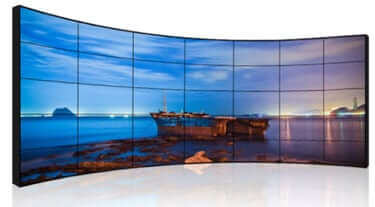
Video wall made of monitors is a structure composed of multimedia elements (video cubes or plasma panels) that form a single monolithic poly-screen. It guarantees high image quality thanks to the use of appropriate modules, usually Full HD 1080p.
Seamless video walls are becoming increasingly popular in the Digital Signage segment. They are used in: shopping and entertainment centers, financial institutions, dispatch centers, control rooms, conference halls, and situation centers.
Many successful companies intend to buy a video wall today, as it becomes an excellent investment for business. Research shows that installing video walls contributes to a 15% increase in sales and nearly a tenfold increase in visitors.
Read more about the technical implementation and equipment here
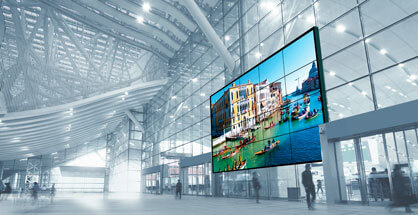
Video walls:
- open up unlimited informational possibilities for you;
- allow displaying detailed large-size images on the screen;
- enable the creation of video installations;
- become a bright element of both outdoor and indoor advertising.
The image can be displayed across the entire wall, on its sections, or on each monitor individually. A video wall made from TVs can be installed in a straight line, semicircle, or wrap around a corner.
Technical Features of Video Walls
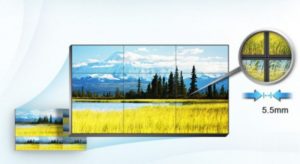
Considering that the video wall consists of multiple screens, its creators aim to achieve perfect image integrity, so they choose displays with minimal bezel width or completely seamless screens. This reduces the thickness of seams, makes them less noticeable, and improves overall aesthetics.
Seamless video wall is often a video wall made of video cubes. It has almost no visible gaps, making this modification the most attractive to buyers. For high-quality and stable operation, video cubes are adjusted according to various parameters: color, brightness, and others. Video wall control is carried out using a controller.
LCD panels for video walls require periodic servicing, which depends on the location of the main modules. If they are located on the rear side of the screens, the video wall installation must maintain the necessary distance from the wall to provide technical specialists access to the working units. Panels can be mounted flush against the wall only if the screens have front access and servicing requires only lifting the monitor.
Variety of Modifications
Video walls differ in:
- monitor size, which can range from 42 to 55 inches;
- number of screens;
- bezel thickness between displays (minimum width – 5 mm, maximum – 22 mm);
- brightness;
- resolution;
- image format;
- number of information sources;
- installation method.