

Competition exists in every field and always will.
The question is how to maintain balance and a leading position in such a difficult time for the whole world. COVID‑19, unfortunately, continues to accelerate, bringing serious changes to business models established over decades — disrupting people’s lives and economies.
Let’s talk about how to grow your business and get maximum feedback from customers.
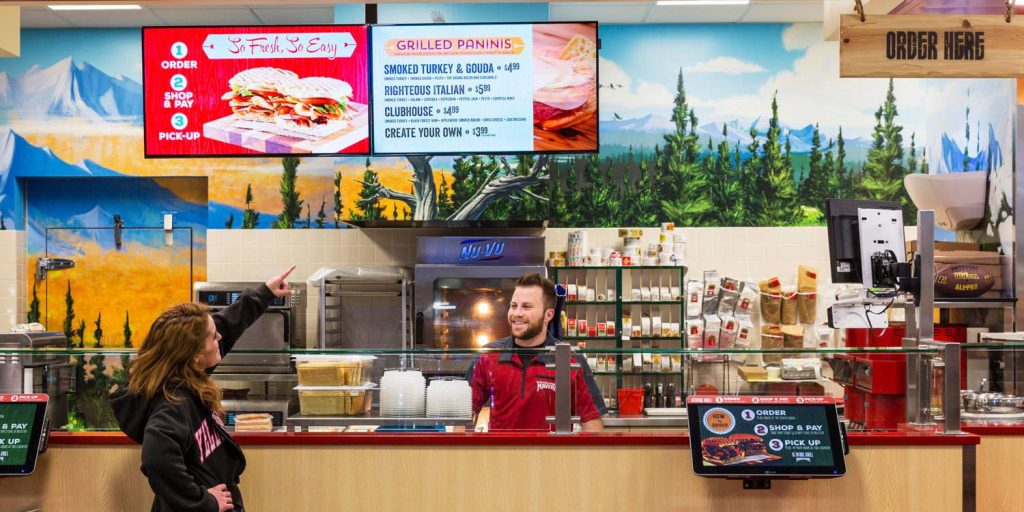
Where possible, offline businesses are now trying to move online or adopt an omnichannel model, which we covered in one of our earlier articles. That means traditional communication methods are becoming outdated and being replaced by innovative, technological Digital Signage solutions — centralized content‑management systems across different playback devices.
One of the most effective ways to grow your business is high‑quality multifunctional digitalization that will powerfully highlight your niche among competitors. And that’s far from all the advantages of DIGITAL SIGNAGE solutions and centralized systems for managing audio, video and interactive content.
That’s exactly what we’ll discuss below:
We’ve prepared 11 of the most innovative, in‑demand and effective examples of non‑standard solutions used in retail over the past few years.
-
QR codes
In 2016 the Chinese e‑commerce giant Alibaba opened its first Hema store in China. The supermarket concept combines offline and online shopping to make the process as convenient as possible for customers. In the store, shoppers can scan QR codes on products to receive additional product information or special discounts.
Payment can also be made through the Hema app, making purchases fast and convenient, and ALL transaction data
is made available to the network, which increases the likelihood of repeat purchases in the short term.
Another impressive element is the digital restaurant at Hema, served by robots.
Customers can use the app to reserve a table and place an order.
Robots completely replace the work of waitstaff.
A rather impressive sight.
Our partners at TDO Cafe‑Bistro in London, while NOT yet fully robotizing their processes, have installed a Digital Signage solution based on the iDS Cloud hardware‑software platform and a centralized content‑management system in the HoReCa segment, enabling full remote control of café business processes.
-
Autonomous shopping carts — 7Fresh
In another part of China, Alibaba’s competitor JD.com opened the high‑tech supermarket 7Fresh, which debuted in 2018 and includes technology that makes shopping as convenient as possible.
One key feature is the SMART shopping cart that follows customers around the store (instead of being pushed).
This allows customers to keep their hands free to care for children or handle other tasks.
The Ukrainian retail market is also rapidly developing and digitalizing. One of our successful projects was implemented for a chain of children’s toy supermarkets. We proposed a conceptual approach to the project — a centralized content‑management format for the Bi “House of Toys” network:
- Centralized management of audio (advertising/informational and background) content with flexible playlist creation (including variable volume levels);
- Multi‑level control of video playback on advertising monitors along counters and in store windows;
- Centralized control of content on interactive panels and touch monitors placed in specific store zones according to the updated brand book.
-
Specsavers’ Frame Styler tool
Choosing glasses can be long and exhausting — customers try on dozens of pairs before finding the right fit.
In 2018 Specsavers launched a new in‑store service to simplify this process.
Frame Styler is an image‑processing software tool that creates a 3D model of the customer’s face on a tablet. Based on that model, it selects frames that best fit the face shape, gender and age. Customers can then virtually try on several styles in 3D, quickly comparing pairs in seconds. It’s also completely safe and hygienic (especially relevant during a pandemic). You don’t need to put dozens of previously tried‑on frames on your face.
A convenient and timely technology that simplifies trying on and choosing the perfect glasses.
Importantly, this feature makes eyewear selection safe and available in both offline and online stores across the network.
So take note of this idea — we’d be glad to help implement it in your business.
-
Nike’s global flagship store
In 2018 Nike opened the “Nike House of Innovation 000” store in New York. As the name suggests, it impresses with digital elements that create an immersive and vivid message for shoppers, elevating the consumer experience.
This app is especially relevant for fans of online shopping. Often a favorite pair of sneakers is found online but is out of stock in the store.
The “Speed Shop” feature allows customers to reserve footwear online to try in‑store.
Customers place an order on the website, then come to the store, find a locker labeled with their name (which can be unlocked with a smartphone), and try on their shoes.
-
Amazon Go — automated checkout
Amazon continues to grow and remains No. 1 in global e‑commerce. Now the brand intends to claim its share of offline retail as well.
Go stores use a combination of computer vision and unique scanning sensor technologies to automate checkout and order processing.
This means customers can enter the store, select items, and leave without queuing.
Payment is processed automatically via the Amazon Go app.
There are currently nine Amazon Go stores in the U.S., and management says they plan to scale the project across the entire network and open thousands of stores worldwide.
-
Kroger’s digital shelf tags
In 2018 the U.S. grocery chain Kroger introduced digital shelf tags in hundreds of stores.
This technology, called “Kroger Edge,” displays pricing and nutritional information digitally, allowing the store to update it instantly and remotely.
According to Microsoft, Kroger Edge runs on alternative energy sources and therefore significantly reduces electricity costs.
Many global brands are increasingly concerned about the environment.
Kroger Edge may become an example of a high‑tech breakthrough in energy saving that many will soon want to emulate.
-
Target’s mobile wallet
Target launched a mobile wallet designed for faster and more convenient payments and checkout.
Remarkably, payment via Target’s mobile wallet is four times faster than a regular payment. Users can pay with their Target REDcard or a credit card and also receive discounts. As in‑app customer activity grows, this payment technology can be an excellent way to increase sales and engage customers actively.
-
Interactive windows — Ted Baker
Windows are the face and magnet of stores. They’re typically used to attract shoppers. But Ted Baker made a breakthrough by making its storefronts interactive.
In collaboration with Nexus Studios, they installed interactive windows at their Regent Street store to promote the “Keep Up With The Bakers” campaign.
Passersby were invited to approach the window, activate the camera, have their photo taken, then see themselves integrated into scenes from the “Keep Up With The Bakers” film and share the result on social media. Everyone could also enter a prize draw to win £1,000 in store credit.
This interactive technology not only encouraged passersby to enter the store but also increased interest in the Ted Baker brand, making it truly notable and successful.
-
Innovative Audi VR showroom
Car buying can start at home. That’s how many prospective Audi owners begin their journey.
Last year Audi launched virtual reality in international showrooms to offer a more personalized customer experience (CX).
The VR experience allows customers to configure their dream car and explore exterior and interior details in depth.
With VR, Audi offers a dynamic, interactive purchasing process that moves beyond a digital tablet to something more engaging.
-
Virtual beauty center — Virtual Artist
Sephora is known for its active web strategy in promotion and marketing and plans to integrate digital technologies across all customer touchpoints.
Since 2017 stores in France have been equipped with innovative Digital Signage technologies. A key part of this service is the Beauty Hub, which includes a virtual Lookbook and the Virtual Artist service.
The app allows customers to “virtually transform” by trying on different makeup looks in the virtual application.
This innovation has become incredibly popular and excites both customers and beauty professionals.
-
Topshop’s VR water slide
Topshop used technology to entertain and draw attention to its storefronts.
They turned their Oxford Street windows into an interactive pool.
Using an Oculus Rift headset, customers could experience a 360‑degree ride on a virtual water slide, spinning and flipping above the crowd below. Though it sounds frivolous, reports suggest the campaign positively impacted sales.
Digital agency Elmwood reported that sales of wetsuits rose by 100% compared with the same period the previous year.
In conclusion, any even the most extraordinary idea can be realized through digital digitalization.
Note that Innovative DMC has ten years of experience in developing, implementing and monetizing Digital Signage solutions (LCD advertising monitors and digital menus, LED advertising screens, electronic price tags and other digital applications) across Ukraine, the CIS, Europe and the UK.
We are open to new bright projects and to getting to know you and your business!